Run AI Where the Data Is Created
On-device vision models, edge VLMs, and edge-cloud model cascades that deliver real-time intelligence — with cloud costs that scale with incidents, not footage, and data that stays on-site.
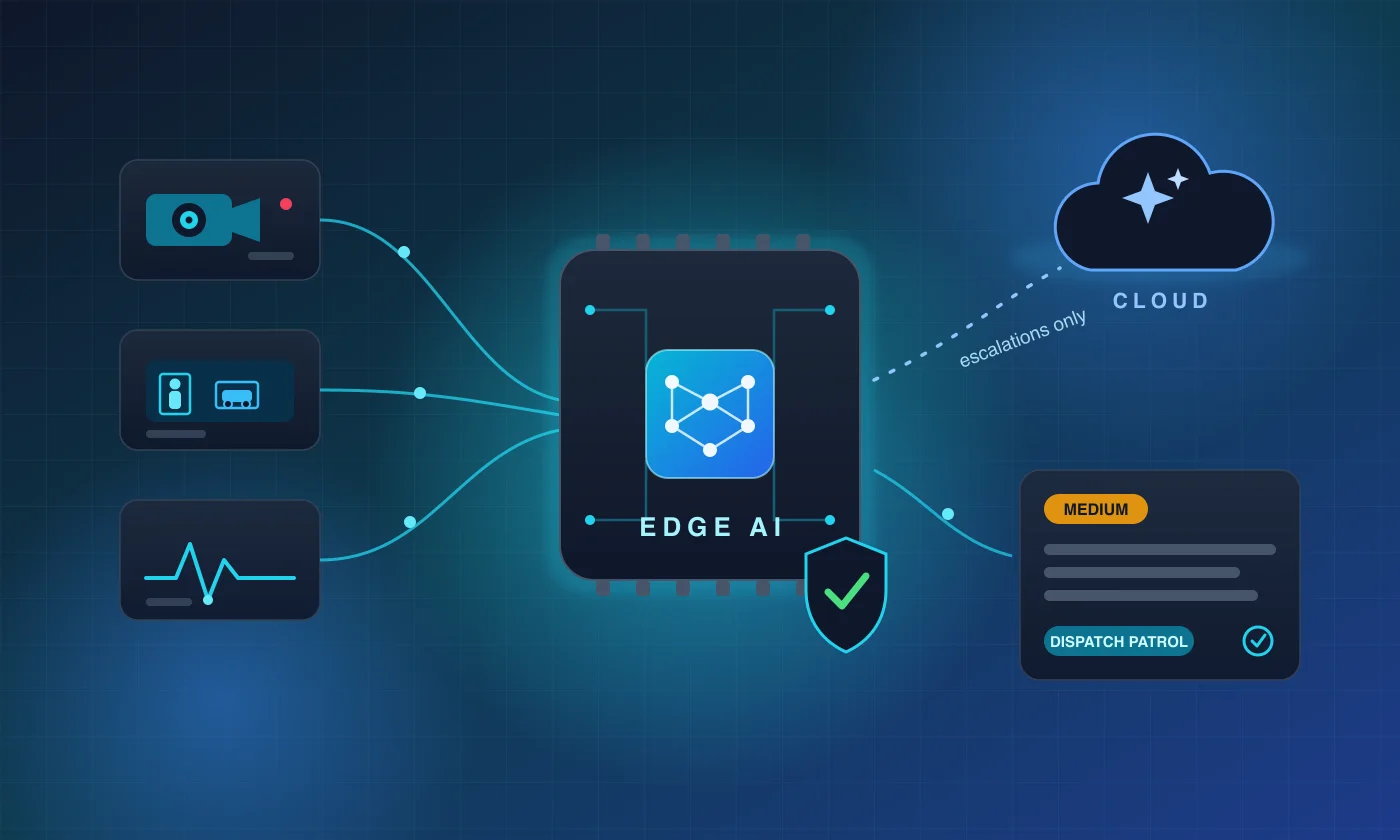
The Edge–Cloud Cascade
Filter at the edge. Refine in the cloud.
One pattern behind everything we build: cheap models watch everything, expensive models see only what matters.
Cameras & Sensors
Live RTSP streams from any IP camera, uploaded footage, and sensor feeds.
Detect · Track · Triage
YOLO11 detection, ByteTrack tracking, and zone rules — then a compact VLM asks "would a guard look twice?"
Deep Analysis
A frontier VLM analyzes escalated events only: summary, risk level, recommended action.
Searchable Incidents
Every incident indexed with evidence — searchable in plain language, in seconds.
Capabilities
Edge AI systems we build
As an AI-native services company, we build production edge AI end to end — from real-time Vision AI on a single camera to fleet-wide edge-cloud cascades, across vision models, VLMs, ML development, and the emerging vision-language-action frontier.
On-Device Vision Models
Real-time object detection, multi-object tracking, and zone analytics running directly on edge hardware — at camera frame rates, without a cloud round-trip.
Vision-Language Models at the Edge
Compact VLMs like Gemma and Qwen-VL running on-device for scene understanding and event triage — reasoning about what the camera sees before anything leaves the box.
Edge–Cloud Model Cascades
Filter-and-refine architectures: a cheap edge model triages every event, and a frontier cloud VLM analyzes only what gets escalated — cutting costs while raising quality.
Real-Time Video & Sensor Ingest
Production-grade ingestion for live feeds — RTSP from any IP camera, WebRTC live viewing, and ring-buffer evidence capture with pre-roll and post-roll.
Model Optimization & Embedded Deployment
Making models fit the hardware you have — quantization, pruning, and runtime optimization, deployed to Jetson, Raspberry Pi, NPUs, and industrial edge boxes.
Vision-Language-Action & Physical AI
The frontier of edge AI: VLA models that close the loop from perception to reasoning to action — robotics, autonomous inspection, and machines that act on what they see.
Use Cases
Where edge AI pays off
If a camera or sensor produces more data than you can afford to ship, store, or watch, edge AI turns it into decisions on the spot. These are the settings where we see it deliver.
Security & Video Intelligence
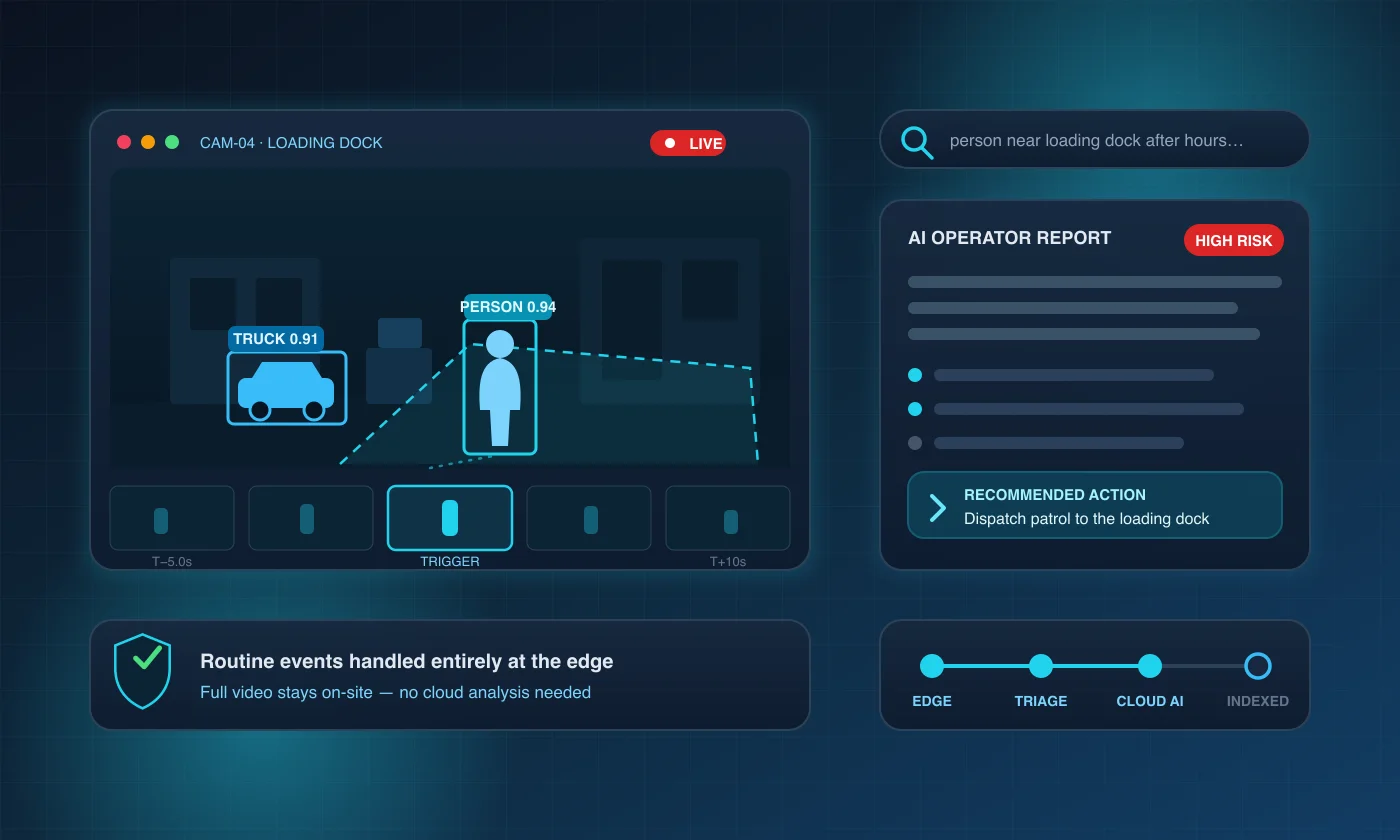
Turn existing cameras into an AI operations layer: on-device detection, edge VLM triage, AI operator reports, and semantic incident search — built as the reasoning layer on top of your VMS.
Workplace Safety & PPE Compliance
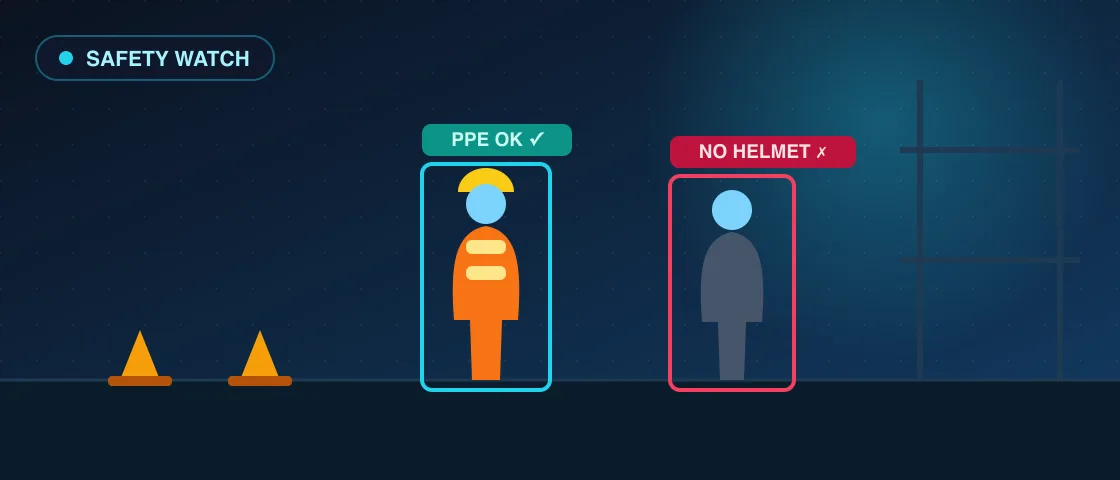
Safety incidents don't wait for a cloud round-trip. Cameras on factory floors, construction sites, and loading docks feed an edge box that flags missing PPE, restricted-zone entries, and down-person events in real time — and alerts a supervisor while it still matters.
What we build
- Hard-hat, vest, and harness detection tuned to your site conditions and camera angles
- Restricted and hazardous zone monitoring with dwell rules and machine-proximity alerts
- Down-person detection with immediate multi-channel alerting and escalation
- Near-miss analytics that turn close calls into safety-program evidence
Why edge: Alerts fire in under a second, on-site — and footage of your workforce never leaves the premises.
Visual Quality Inspection
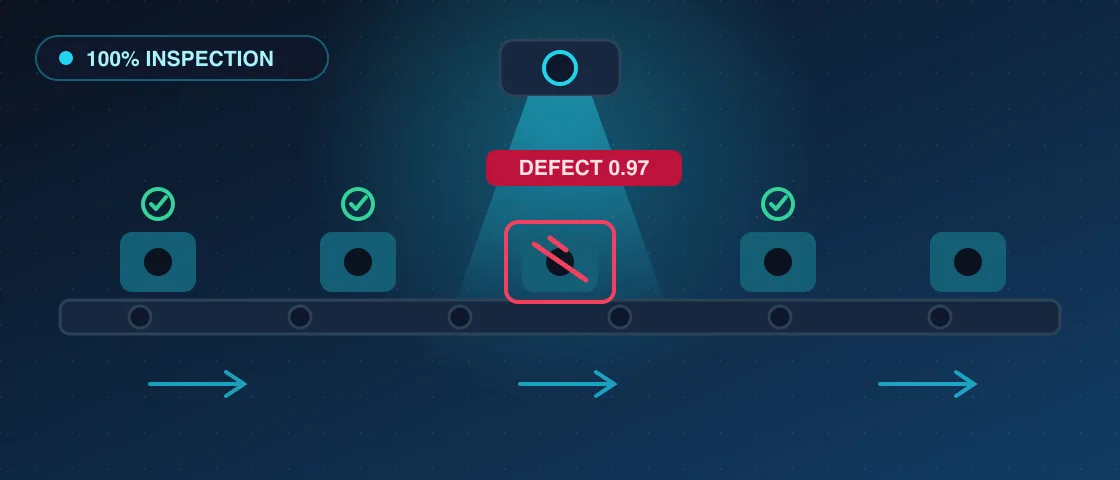
A camera over the line sees every unit; a human inspector sees a sample. Edge vision models inspect 100% of production at line speed, catching defects the moment they appear instead of at the end-of-shift audit.
What we build
- Surface-defect and anomaly detection trained on your good and bad parts
- Assembly-completeness verification at station or end-of-line
- VLM-based inspection for variable products where classic CV models struggle
- Reject tracking and defect-trend dashboards tied to batch and shift data
Why edge: Inference next to the camera keeps up with line speed — no bandwidth bill for streaming every part to the cloud.
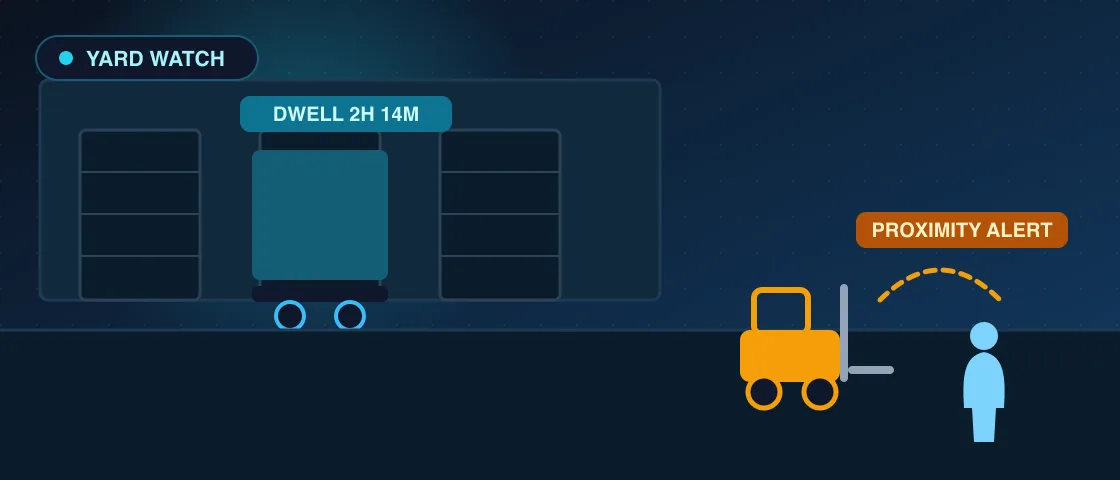
Logistics & Yard Operations
Docks, gates, and yards generate hours of footage nobody watches. Edge AI turns those cameras into a live operational record: which trailer is at which door, how long it has dwelled, and whether a forklift and a pedestrian are about to meet.
What we build
- Dock-door occupancy and trailer dwell-time tracking across the yard
- Forklift-pedestrian proximity alerts in shared aisles and staging areas
- Gate activity logging with vehicle classification and timestamped evidence
- Natural-language search over yard events — "trailers that dwelled over two hours last week"
Why edge: A facility with 40 cameras streams nothing offsite — events, not footage, reach your WMS or yard system.
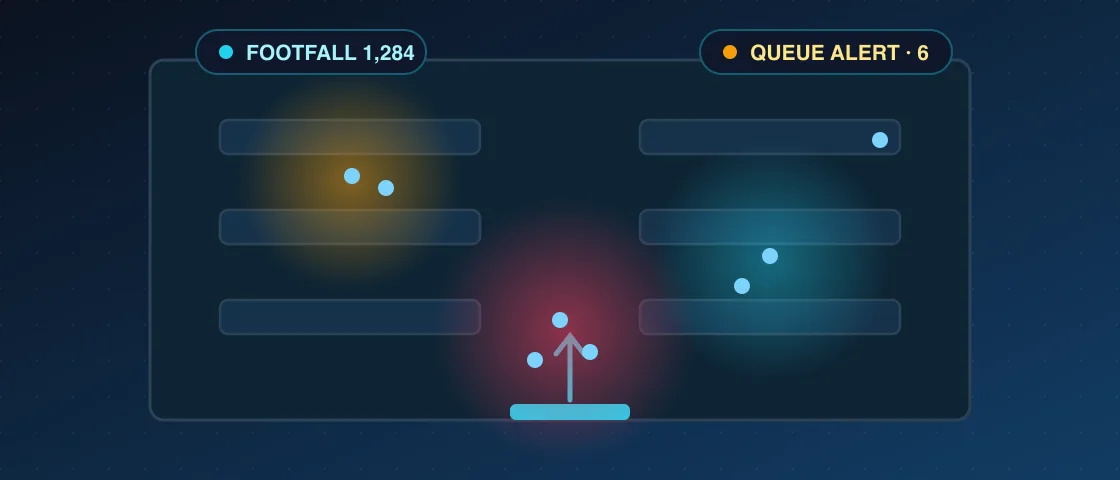
Retail & Space Analytics
Understanding how people move through a store shouldn't mean shipping their video to a data center. On-device models turn existing cameras into anonymous counters and heat-mappers, with privacy built in at the architecture level.
What we build
- Footfall counting and occupancy by zone, hour, and entrance
- Queue-length detection with staffing alerts before lines form
- Zone heat-maps showing how layouts and displays actually perform
- After-hours intrusion and loss-prevention event detection
Why edge: Counts and heat-maps leave the store; faces and footage never do — a materially easier privacy story.
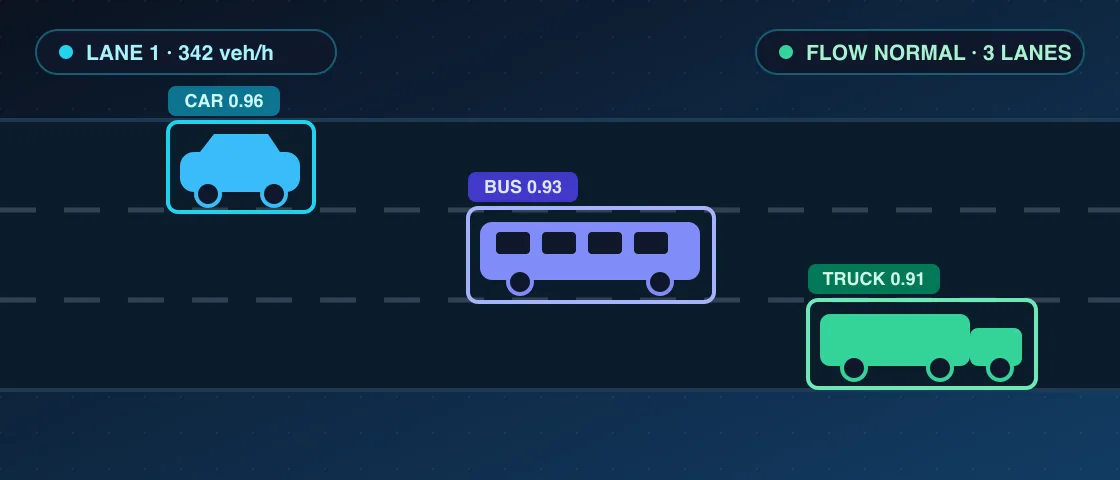
Traffic & Smart Infrastructure
Roadside and intersection cameras become traffic sensors: counting, classifying, and measuring flow in real time — without backhauling video from hundreds of poles to a data center.
What we build
- Vehicle counting and classification (car, bus, truck, motorcycle) per lane and direction
- Parking occupancy and turnover analytics for lots and curbside
- Wrong-way, stopped-vehicle, and pedestrian-in-roadway event detection
- Flow dashboards feeding signal-timing and infrastructure-planning decisions
Why edge: Each pole needs a cell link that carries events and counts — not a fiber line that carries video.
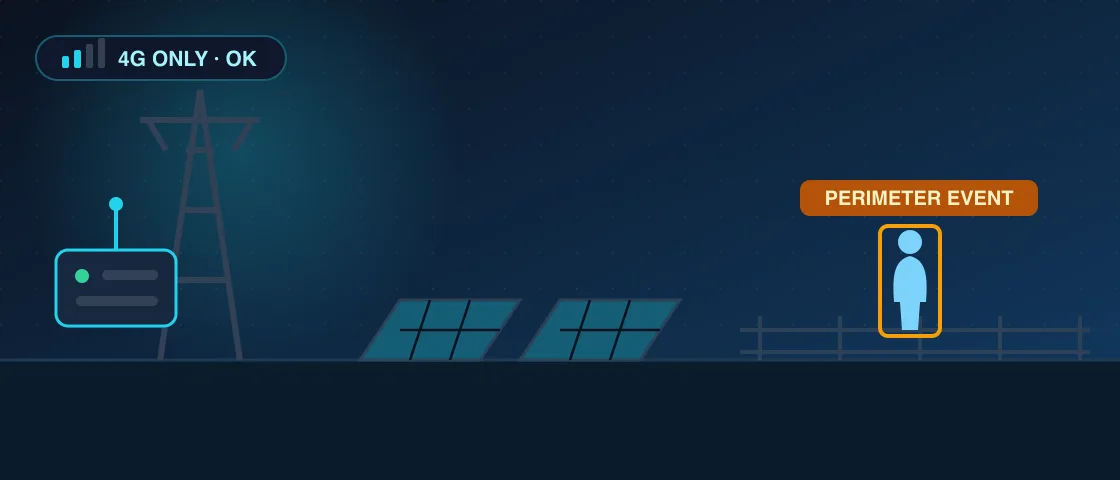
Remote Site & Asset Monitoring
Substations, solar farms, tank farms, and construction sites sit where bandwidth is thin and patrols are expensive. An edge box watches locally, stores evidence locally, and escalates only what matters over whatever link exists.
What we build
- Perimeter and intrusion monitoring with VLM triage that kills false alarms from wildlife and weather
- Equipment-tampering and theft detection for copper, tools, and materials
- Offline-tolerant capture that buffers through outages and syncs when connectivity returns
- Fleet management for dozens of unmanned sites from a single console
Why edge: Designed for sites where a 4G link is all you get — the AI doesn't need the cloud to keep watching.
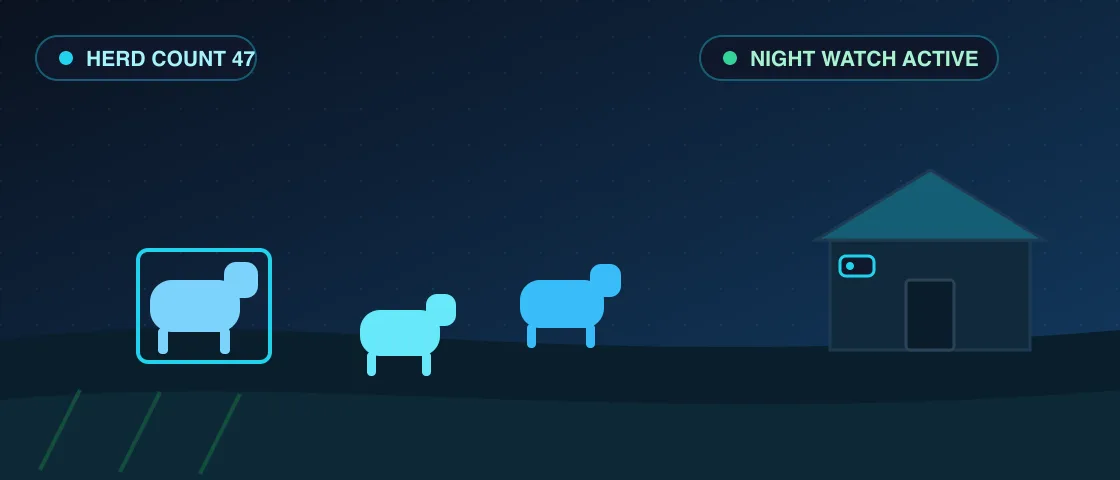
Agriculture & Livestock
Vision AI in the field: counting and monitoring livestock, scouting crops, and watching machinery — in places where connectivity is a maybe and a missed event costs real money.
What we build
- Livestock counting, tracking, and behavior-change detection in barns and feedlots
- Calving, lambing, and distress-event alerts through the night
- Crop scouting from fixed cameras or scheduled drone passes
- Machinery, gate, and water-point monitoring across the operation
Why edge: Runs on a barn-mounted box with intermittent connectivity — alerts go out the moment the link is up.
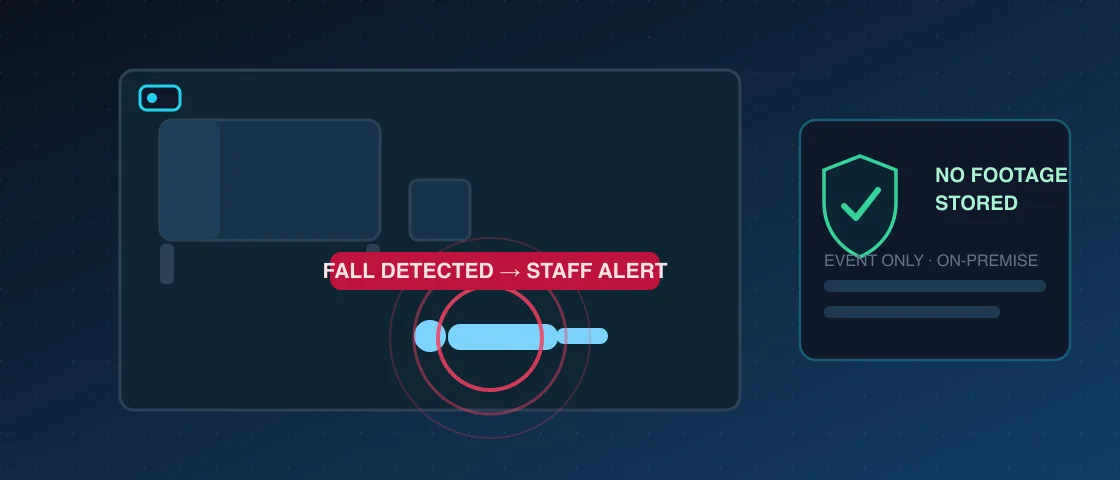
Healthcare & Assisted Living
The most privacy-sensitive video there is. Edge processing means analysis happens in the room or the building, and only events — never footage — reach staff systems, which is what gets these deployments through compliance review.
What we build
- Fall and down-person detection with immediate staff alerts
- Wandering and elopement alerts for memory-care settings
- Room-occupancy and activity monitoring without recording
- On-premise-only deployments designed to clear hospital IT and privacy review
Why edge: Analysis without archiving: the system can alert on a fall without ever storing or transmitting the video.
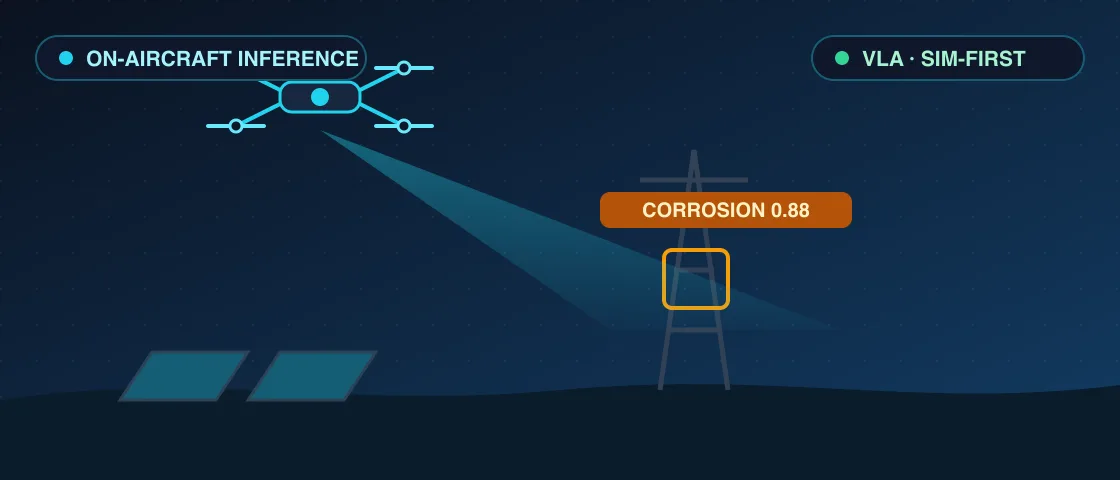
Drones & Autonomous Inspection
Perception for machines that move: drone inspection footage analyzed on the aircraft or at the ground station, mobile robots that understand what they see, and the emerging vision-language-action frontier where models don't just perceive the world — they act on it.
What we build
- Aerial inspection pipelines — corrosion, vegetation encroachment, panel defects — analyzed on landing
- Perception stacks for AMRs and inspection robots operating alongside people
- VLA prototypes: perception-to-action loops with simulation-first validation
- Safety guardrails and human-oversight patterns for anything that moves
Why edge: A drone can't wait on a data center — inference has to fly with it.
Delivery Approach
How we ship production edge AI
One live code path from lab rig to production hardware — so every hour of development testing hardens the system you actually deploy.
Use-Case & Hardware Assessment
Define latency, privacy, and cost requirements, audit camera and sensor infrastructure, and pick the right edge topology — customer-edge box, on-prem GPU, or hybrid.
Model Selection & Cascade Design
Choose detectors, trackers, and VLMs sized for your hardware, and design the edge-cloud split: what runs on-device, what escalates, and when.
Edge Pipeline Development
Build the ingest-to-inference pipeline — streaming, detection, tracking, event rules, and triage — with one code path from lab rig to camera wall.
Optimization & Deployment
Quantize and optimize models for the target runtime, containerize the stack, and deploy with clean edge/central boundaries.
Fleet Monitoring & Improvement
Liveness heartbeats, per-stage telemetry, and model performance tracking — iterating as real-world data comes in.
Use-Case & Hardware Assessment
Define latency, privacy, and cost requirements, audit camera and sensor infrastructure, and pick the right edge topology — customer-edge box, on-prem GPU, or hybrid.
Model Selection & Cascade Design
Choose detectors, trackers, and VLMs sized for your hardware, and design the edge-cloud split: what runs on-device, what escalates, and when.
Edge Pipeline Development
Build the ingest-to-inference pipeline — streaming, detection, tracking, event rules, and triage — with one code path from lab rig to camera wall.
Optimization & Deployment
Quantize and optimize models for the target runtime, containerize the stack, and deploy with clean edge/central boundaries.
Fleet Monitoring & Improvement
Liveness heartbeats, per-stage telemetry, and model performance tracking — iterating as real-world data comes in.
Tooling & Stack
The stack we deploy — and why
Technology choices you can audit: what we use, where it runs, and the reasoning behind each pick. Every layer is swappable behind clean interfaces, so the architecture outlives any single model or vendor.
Detection & Tracking
We standardize on Ultralytics YOLO11 for real-time object detection — the nano and small variants hold camera frame rates even on CPU-only edge boxes — with ByteTrack via Supervision for identity-stable multi-object tracking. Detection itself is a commodity; the durable value is the event layer we build on top: zone rules, dwell logic, and alarm sessions that turn raw detections into operational events instead of alert noise.
Edge VLMs & Small Models
Compact vision-language models in the 2–8B range — the Gemma and Qwen-VL families — served through Ollama or llama.cpp on the edge box. Scoped to bounded judgments like event triage, they deliver near-frontier reliability at zero marginal cost per inference. Every deployment sits behind an OpenAI-compatible provider interface, so swapping models or moving from hosted to on-device is a configuration change, not a rewrite.
Frontier Cloud Analysis
Frontier multimodal models handle what small models can't: nuanced scene reasoning, risk assessment, and operator-grade report writing. Because the edge cascade filters routine events first, frontier-model spend tracks incidents rather than footage hours. We benchmark Claude and Gemini per use case, and the same provider abstraction keeps you free to follow the price-performance frontier as it moves.
Model Optimization
Getting a model to fit its hardware is where edge projects live or die. We quantize to INT8/FP16, prune, and compile per target: TensorRT on NVIDIA GPUs and Jetson, OpenVINO on Intel CPUs and NPUs, CoreML on Apple silicon, and ONNX Runtime as the portable baseline. The trade-off we tune is always the same triangle — latency, accuracy, and power — measured on your hardware, not on a spec sheet.
Edge Hardware
We deploy from Jetson Orin-class GPU boxes running multi-stream detection plus on-device VLM inference, down to Raspberry Pi-class ARM boards running quantized nano detectors. Hardware selection comes after requirements — stream count, model mix, latency budget, power envelope, and unit economics at fleet scale — and single-box Docker deployments keep field provisioning and hardware swaps boring.
Streaming & Data
RTSP is the ingestion standard every IP camera speaks — supporting it properly means real cameras need zero new ingest code. WebRTC handles low-latency live viewing, FFmpeg handles browser-ready clip transcoding, and MQTT carries sensor events. On the data side, PostgreSQL with pgvector gives us evidence storage and semantic search in one boring, operable database — no separate vector store to babysit.
Outcomes
Why teams move AI to the edge
Real-time by default
Decisions at camera frame rates — no cloud round-trip in the critical path.
Costs scale with incidents
Your cloud AI bill tracks real events, not hours of raw footage.
Privacy by architecture
Full video stays on-site; only keyframes of escalated events ever leave.
Survives outages
The edge box keeps detecting and recording when the network doesn't.
Scales per-site
Bandwidth stays flat as cameras grow — add streams, not cloud spend.
Ready to put AI at the edge?
Let's map your latency, cost, and privacy requirements to an edge AI architecture — and prove it on your data in weeks, not quarters.
FAQs
Questions about Edge AI
How we design, deploy, and operate AI systems at the edge.
Still have questions? Talk to an engineerEdge AI runs machine learning models on or near the device that produces the data — a camera, a sensor gateway, an industrial PC — instead of shipping everything to the cloud. It makes sense when you need real-time responses (video analytics, safety monitoring), when bandwidth or cloud inference costs would explode with data volume, when data is sensitive and should stay on-site, or when the site must keep working through network outages. Most production systems we build are hybrid: fast, cheap models at the edge with selective escalation to frontier cloud models.
Any setting where cameras or sensors produce more data than you can afford to ship, store, or watch. The most common wins we deliver: workplace safety and PPE compliance on construction sites and factory floors; visual quality inspection on production lines; security and video intelligence on top of existing VMS platforms; logistics and yard operations (docks, forklift-pedestrian safety); retail footfall and queue analytics; traffic and smart-infrastructure monitoring; remote sites like substations and solar farms with limited bandwidth; agriculture and livestock monitoring; privacy-sensitive healthcare settings like fall detection in assisted living; and perception for drones and autonomous inspection robots.
Yes. Compact VLMs in the 2-8B parameter range — Gemma and Qwen-VL families, for example — run well on modern edge boxes via runtimes like Ollama, and handle scene-understanding tasks like event triage reliably. The key is scoping the edge model to a well-defined judgment (e.g., "is this event worth a closer look?") and cascading to a frontier model like Claude or Gemini for deep analysis. We design the interface so models and hosts are swappable by configuration alone, so you can upgrade as smaller models improve.
We split by latency, cost, and privacy. Anything that must react in real time — detection, tracking, zone rules, first-pass triage — runs at the edge. Expensive reasoning that only matters for a minority of events — detailed incident analysis, report generation, semantic indexing — runs in the cloud, and only on escalated events. Done right, the cascade means routine activity is handled entirely on-device: your cloud bill tracks real incidents, not hours of footage, and raw video never leaves the site.
We deploy to NVIDIA Jetson-class devices, industrial x86 edge boxes with or without GPUs, Raspberry Pi-class ARM boards, and devices with dedicated NPUs. Model choice follows the hardware: CPU-only boxes run optimized nano detectors well; GPU-equipped boxes add real-time multi-stream processing and on-device VLM inference. We use quantization and runtime optimization (ONNX Runtime, TensorRT, OpenVINO, CoreML) to hit your latency and power targets, and we validate the same pipeline from a lab rig to a production camera wall.
The architecture itself is the privacy control. Full-resolution video stays on your premises; when an event escalates to cloud analysis, only a handful of downsampled keyframes leave the box — and routine events never leave at all. Every decision carries an audit trail recording which model ran, where it ran, and what it saw. This makes GDPR and internal-compliance conversations much simpler than any all-footage-to-cloud design, and supports fully air-gapped deployments where required.
A focused proof of concept on your footage — detection, tracking, triage, and a review console — typically takes 4-8 weeks. A production pilot with live camera ingest, edge deployment, and cloud analysis usually lands in 8-16 weeks depending on site count, hardware procurement, and integration with existing systems like VMS platforms or alerting tools. We phase delivery so you see the pipeline working on real data early, before committing to fleet rollout.
Turn Your Vision IntoReality
Get a free consultation and discover how we can accelerate your product development with AI-powered solutions.
Launch 40% Faster
AI-powered development reduces time-to-market significantly
Scale with Confidence
Built for growth with enterprise-grade architecture
24-Hour Response
We'll get back to you within 24 hours with a detailed proposal