Edge AI VideoIntelligence Platform
Turn camera footage into searchable incidents and AI-generated reports — with on-device detection and edge VLM triage, so the cloud only analyzes what matters.
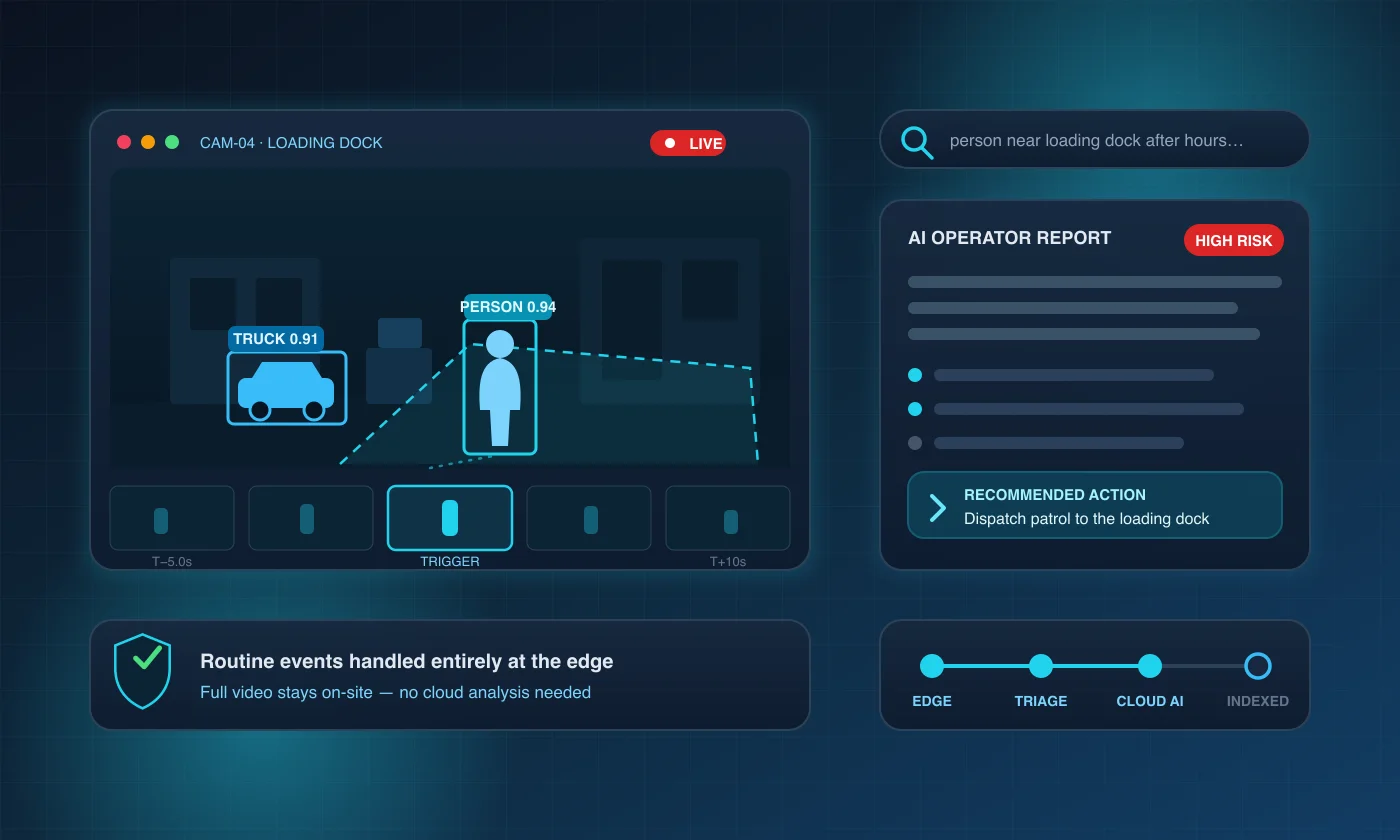
The reasoning layer on top of your existing cameras and VMS: detect → triage at the edge → analyze in the cloud → search everything.
How It Works
Video → Event → Evidence → Investigation → Search
An edge-cloud model cascade that watches every camera, so your operators only look at what matters.
Cameras
Live RTSP streams from any IP camera, or uploaded footage — no new hardware.
Detect & Track
YOLO11 and ByteTrack find people and vehicles; zone rules raise events on the edge box.
Edge VLM Triage
An on-device VLM asks "would a guard look twice?" and dismisses routine activity.
AI Operator Report
A frontier VLM writes the report: summary, risk level, recommended action.
Searchable Incidents
Every incident indexed with evidence — findable in plain language, in seconds.
Platform Capabilities
Everything between the camera and the answer
Detection, triage, analysis, search, and evidence — one Vision AI platform covering the full path from a live RTSP stream to a searchable, audited incident.
On-Device Detection & Tracking
Real-time person and vehicle detection with multi-object tracking and zone rules, running entirely on the edge box at camera frame rates.
Edge VLM Triage
A compact vision-language model reviews every event on-device and dismisses routine activity before it ever reaches the cloud.
AI Operator Reports
Escalated events get frontier-model analysis: a clear summary, a risk level, and a recommended action — like an experienced operator would give.
Semantic Incident Search
Search hours of footage in seconds using natural language — "person loitering near the loading dock after hours" — instead of scrubbing timelines.
Live Video Ingest & Viewing
Standard RTSP ingestion from any IP camera with low-latency WebRTC live viewing in the investigation console.
Evidence & Audit Trail
Every incident carries its full evidence chain: clip, keyframes, and a per-stage record of exactly which model decided what, and where.
Outcomes
Stop drowning in alerts
Get reasoned, contextual recommendations the way an experienced operator would give them.
Routine events never hit the cloud
The on-device VLM dismisses routine activity locally — cloud costs scale with real incidents, not hours of footage.
Full video stays on-site
Only a handful of downsampled keyframes from escalated events ever leave the box. Raw footage never does.
Real-time edge detection
Detection, tracking, and zone rules run at the edge against live RTSP streams — no cloud round-trip in the critical path.
Search footage instantly
Natural-language semantic search over every analyzed incident replaces hours of manual timeline scrubbing.
Evidence from before the trigger
Ring-buffered capture preserves five seconds of pre-roll and ten of post-roll — every clip shows the full story.
No event ever lost
Every triage failure escalates instead of dropping — a model or network outage never silently loses an incident.
Our Process
From your footage to fleet rollout
We start with a proof of concept on your recorded footage, then go live — one code path from the first test video to the production camera wall.
Site & Footage Assessment
Review your cameras, zones of interest, and incident types, then validate the pipeline against your recorded footage.
Edge Deployment
Install the edge stack next to your cameras and connect live RTSP streams — no changes to existing infrastructure.
Triage Calibration
Tune the on-device VLM triage and escalation policy so routine activity stays local and real events escalate reliably.
Cloud Analysis & Search
Configure frontier-model analysis, report formats, and the semantic search index over your incident history.
Operator Rollout & Tuning
Train your team on the investigation console and iterate on rules, models, and thresholds with real-world data.
See what your cameras have been trying to tell you
Start with a proof of concept on your own footage — detection, triage, AI reports, and semantic search, working on your real incidents in weeks.
FAQs
Questions about the platform
How the Edge AI Video Intelligence Platform works with your cameras, your VMS, and your privacy requirements.
Still have questions? Talk to an engineerIt's an AI-powered video investigation platform that turns raw camera footage into searchable incidents and AI-generated operator reports. An edge box next to your cameras runs real-time object detection, tracking, and zone rules, then a compact vision-language model triages every event on-device — asking, in effect, 'would a guard look twice?' Only events worth attention are escalated to a frontier cloud model for deep analysis, which produces a summary, a risk level, and a recommended action. Everything becomes searchable in natural language.
No — it sits above them as the reasoning layer. Your cameras, video management system (Avigilon, Milestone, Genetec, or others), and recording infrastructure stay exactly as they are. The platform ingests standard RTSP streams, which every IP camera exposes, so connecting real cameras requires no new hardware and no rip-and-replace. Most security teams drown in alerts; we take the alert, the footage, and the context, and return a reasoned recommendation the way an experienced operator would.
It's a filter-and-refine architecture in three stages. First, a YOLO-family detector with ByteTrack tracking finds people and vehicles and applies your zone rules in real time on the edge box. Second, a compact vision-language model (such as Gemma or Qwen-VL) reviews keyframes on-device and dismisses routine activity — those events are logged and audited but never sent to the cloud. Third, only escalated events go to a frontier model like Gemini or Claude for deep analysis. The triage fails open: if the edge model is ever unavailable, events escalate rather than being dropped, so an outage never loses an event.
Privacy is architectural, not a policy checkbox. Full-resolution video never leaves your site — it stays on the edge box and your existing recording infrastructure. When an event escalates to cloud analysis, only a small set of downsampled keyframes is sent, and routine events are handled entirely at the edge with no cloud contact at all. Every incident carries a full audit trail recording which model analyzed it, where that model ran (on-device or hosted), what images it saw, and what it concluded.
Every analyzed incident is embedded into a vector index (PostgreSQL with pgvector), so operators can search past footage the way they'd describe it to a colleague — 'person loitering near the loading dock after hours' — instead of scrubbing timelines. Searches combine semantic similarity with structured filters like risk level, event type, camera, and time range, returning ranked incidents with their clips, keyframes, and AI reports attached as evidence.
A proof of concept on your recorded footage — detection, triage, AI reports, and the investigation console — typically takes 4-6 weeks. A live pilot with RTSP camera ingest and an edge box on-site usually lands in 8-12 weeks, and fleet rollout across sites follows from there. Because uploaded video and live cameras share one code path, everything validated in the POC carries directly into production.
Turn Your Vision IntoReality
Get a free consultation and discover how we can accelerate your product development with AI-powered solutions.
Launch 40% Faster
AI-powered development reduces time-to-market significantly
Scale with Confidence
Built for growth with enterprise-grade architecture
24-Hour Response
We'll get back to you within 24 hours with a detailed proposal