AI agents that take real actions —
not just answer questions.
Agentic workflows, business process automation, decision support, and AI-powered operations. We design, build, and ship multi-agent systems engineered for production — with guardrails, observability, and human-in-the-loop where it matters.
Most agent projects die between demo and production. We build for what comes after the demo.
Three years ago "AI agent" meant chatbot.
Today it means production systems.
GPT-3.5. Single-turn Q&A. No actions.
Models can request tools with structured arguments. Agent loop becomes feasible.
Guaranteed JSON schemas. Mature vector search. Multi-step agents ship to production at scale.
OpenAI Agents SDK, LangGraph, computer use. Costs drop ~10x year-over-year.
A default layer in the stack. Buyers expect production rigor, not demos.
What we deliver.
Four core capabilities. Most engagements use 2–3 — we scope to what your business problem actually needs, not the full menu.
Multi-agent orchestration
Specialized agents that coordinate via shared state. Intent classifier, planner, executor, jury — each with bounded scope and clear handoff contracts.
Agentic process automation
Agents that take real actions — file tickets, send emails, update records, call APIs — with approval gates and full audit trail. Not retrieval; action.
Decision support
Agents that synthesize signals, score options, and route to humans for review. Augmenting decisions, not replacing accountability.
Observability + evals
Every decision logged with confidence, latency, cost, and tool calls. Eval harnesses catch regressions before production.
A 5-stage methodology, working backward from production.
Each stage is bounded. We ship in 2-week increments so you can course-correct.
Business framing
Map the workflow. Measure baseline cost. Define numeric success.
Agent scope
Bounded responsibility per agent. Avoid the "let GPT-4 do everything" trap.
Tool design
Structured I/O, idempotency, retries, auth. Wire to real systems via APIs.
Evals + observability
Deterministic tests before the code feels stable. Log every decision.
Production deploy
Feature flags. Roll out to one team first. Iterate on what users actually do.
"Multi-agent" is not always better.
Picking the right pattern saves cost, latency, and engineering pain. Here's the four-way decision.
Single-agent
One bounded responsibility
Orchestrator + workers
One coordinator routes to specialists
Multi-agent collaboration
Cross-checking improves quality
Agent as a tool
AI is one step in a deterministic flow
The tools we use — and why.
Vendor-neutral by default. Picked by cost, latency, quality, and data constraints.
Models
Orchestration
Retrieval & State
Quality & Production
Ranges we typically see.
We share the math upfront. No guarantees, but here's what production agent deployments deliver.
What we'd build for your industry.
Agent patterns shift with regulatory and operational constraints. Here's the version we ship per vertical.
Healthcare
BAA-friendly RAG over clinical documentation. Audit logging on every PHI access. Agents that summarize visits, route patient queries, surface care-plan adherence — humans in the loop for clinical decisions.
Fintech
Deterministic decision logging for regulatory traceability. Agents that draft adverse-action notices, triage fraud alerts, summarize KYC documents — model outputs that can be replayed for audit.
B2B SaaS
Multi-tenant agent infrastructure with per-tenant evals and cost attribution. Customer-facing agents (support, onboarding) and internal agents (sales prep, account research) on one platform.
Operations & Logistics
Agents integrated into TMS/WMS systems. Anomaly detection, exception handling, dispatch automation. Decision support synthesizing GPS, ERP, and carrier signals into one recommended action.
Designed for security review from day one.
Data isolation
Row-level tenant isolation. Per-tenant API keys. No cross-tenant fine-tuning. Your data stays yours.
Audit-grade logs
Every decision: input, output, model version, tool calls, latency, cost. Exportable. Immutable. Replayable.
Evals as compliance
Eval suites double as regression tests and compliance evidence for security reviewers and auditors.
Vendor flexibility
Architecture stays portable. Swap models as the market shifts. No lock-in to a single provider.
We sell what we ship.
PostAgent is a multi-agent SaaS we built and operate. The patterns we sell are ones we use ourselves.
Eval harnesses, observability, feature flags from day one. We treat agents like production systems because they are.
We share eval scores, cost breakdowns, and failure modes. No black-box demos that collapse in production.
We pick what fits your constraints. No provider kickbacks. No retrofit lock-in.
Agents in production.
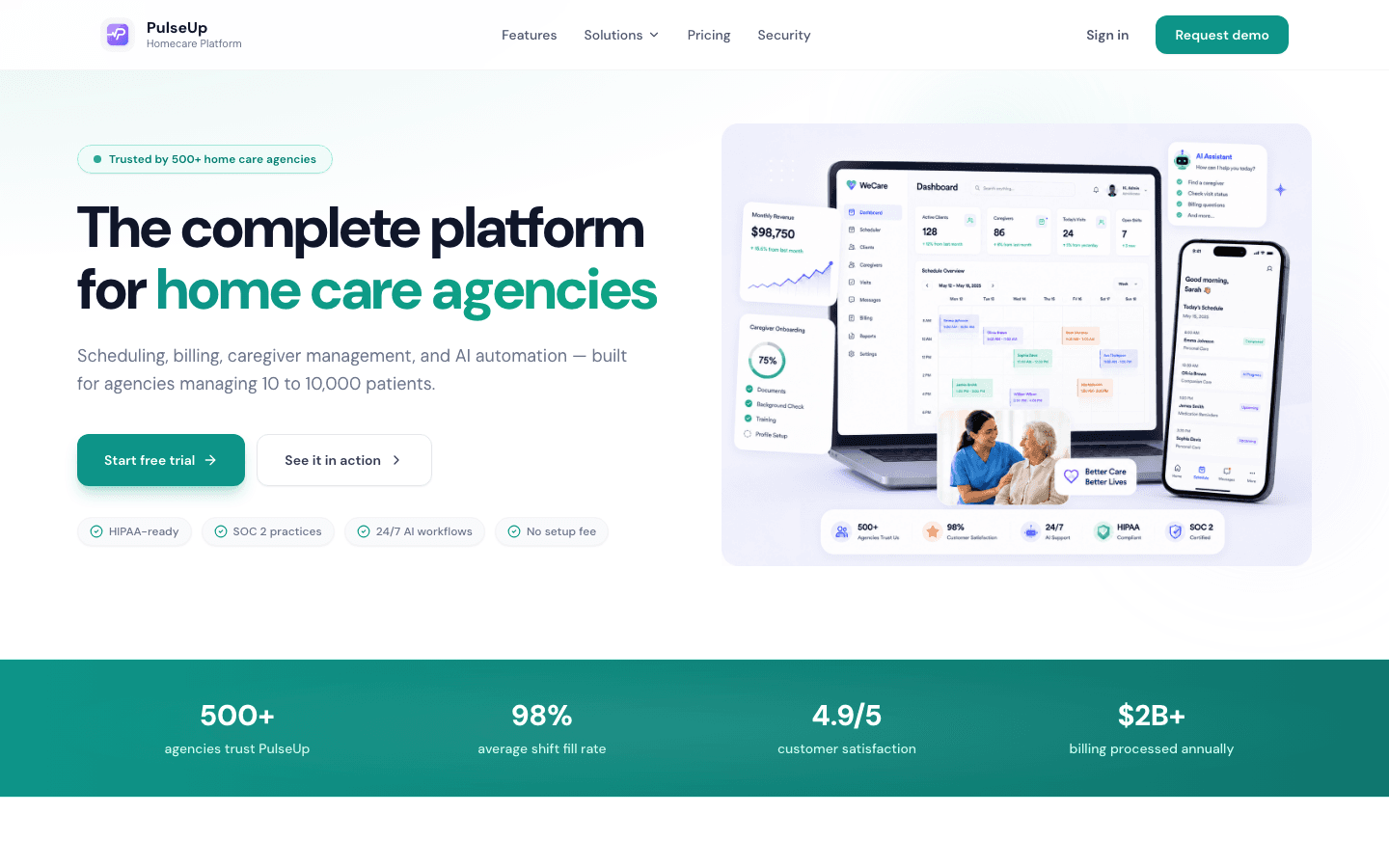
AI Automation for Modern Care Agencies — PulseUp Health
An AI-native home care management platform that automates scheduling, billing, payroll, and family communication for agencies running 10 to 10,000 patients.
View case study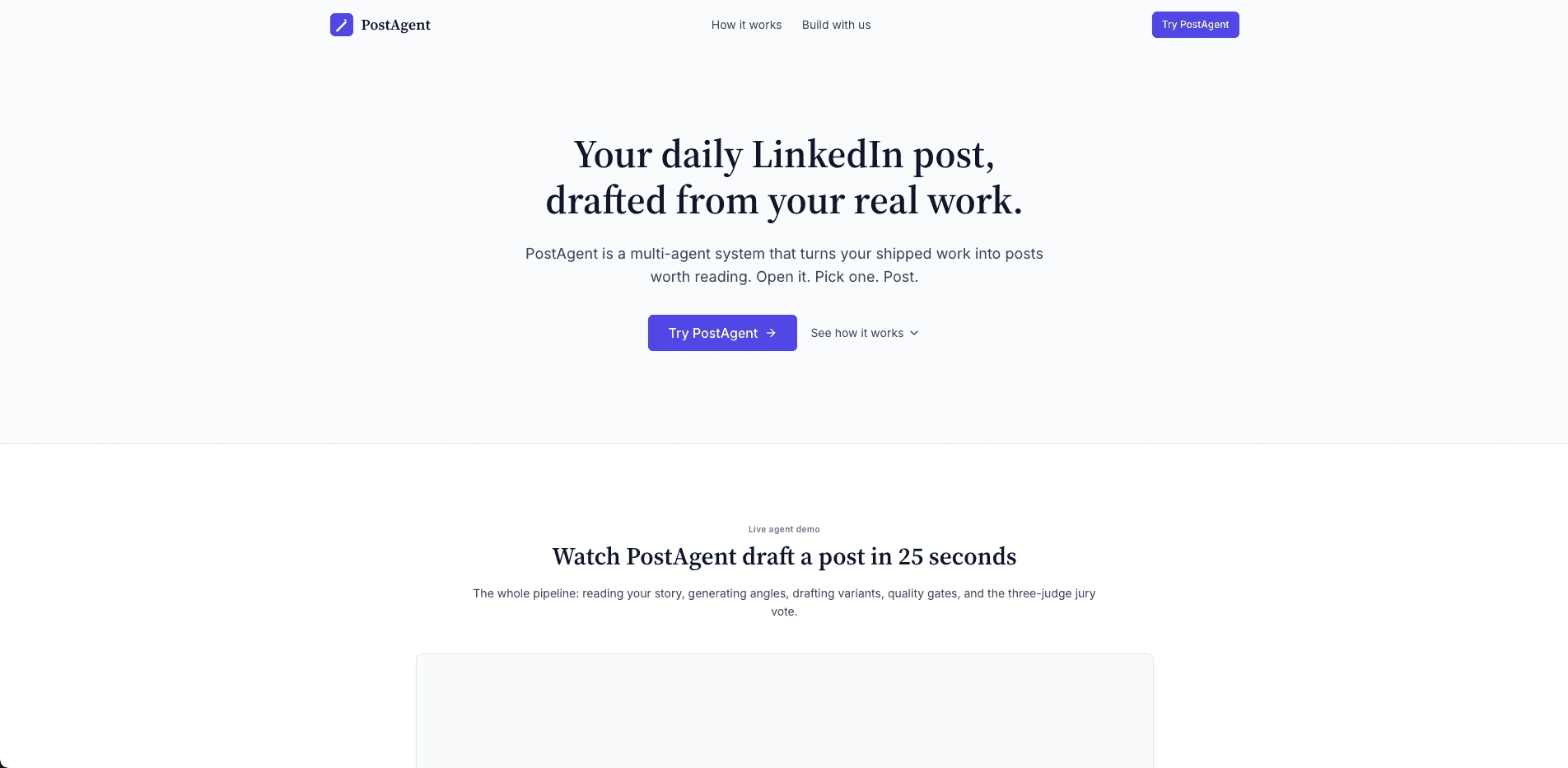
AI Agent for LinkedIn Content — PostAgent
A multi-agent system that turns your shipped work into LinkedIn posts. Reads your real activity, generates angles, drafts variants, runs quality gates, and picks winners with a three-judge jury.
View case study
Customer Support AI Assistant
An AI-native customer support assistant where specialized agents handle intent classification, knowledge-grounded responses, escalation routing, and ticket summarization — replacing tier-1 support load and accelerating tier-2 resolution.
View case studyHonest answers.
Strategy
Engineering
Security & Cost
Ready to ship an AI agent to production?
Tell us what you want the agent to do. We'll come back with a scoped plan, eval roadmap, and a working prototype within 2-3 weeks.
Book a Strategy CallTurn Your Vision IntoReality
Get a free consultation and discover how we can accelerate your product development with AI-powered solutions.
Launch 40% Faster
AI-powered development reduces time-to-market significantly
Scale with Confidence
Built for growth with enterprise-grade architecture
24-Hour Response
We'll get back to you within 24 hours with a detailed proposal